Breaking the Stalemate: From legal deadlock to collaborative resolution
From the Collaborative Practice Training Team who brought you www.cptraining.ca, Runaway Train Using Collaborative Practice to Derail High Conflict Court Cases, and Saving the Golden Goose: Protecting your Bussiness through Collaborative Practice, comes a new workshop called Breaking the Stalemate. Learn how to deal with impasse using a multidisciplinary approach to resolving conflict. Click on the links below to find out more and to download the Stalemate Differential Diagnosis handout.

Carrie Heinzl brings financial-neutral and settlement expertise
Financial Neutral & Settlement Expert
Member of the Law Society of Ontario
Certified Member of International Divorce Financial Analysts (IDFA)
Accredited Family Mediator with the Ontario Association of Family Mediators
Certified Divorce Specialist with the National Association of Divorce Professionals
Board member, York & Durham Collaborative Practice Groups
Board member, Collaborative Practice Canada

Jonathan Paynter adds family-systems and mediation expertise
A family-systems lens for stalled matters
Registered Social Worker, Psychotherapist
Accredited Family Mediator Ontario Association for Family Mediation
Board of Directors, AFCC & OAFM

Russell Alexander brings legal and collaborative-practice depth
Called to the Bar by the Law Society of Ontario in 1998
• Collaboratively trained: Level I & II
• Active member of Kawartha, Durham and York Collaborative Practices
• Member, Collaborative Practice Institute
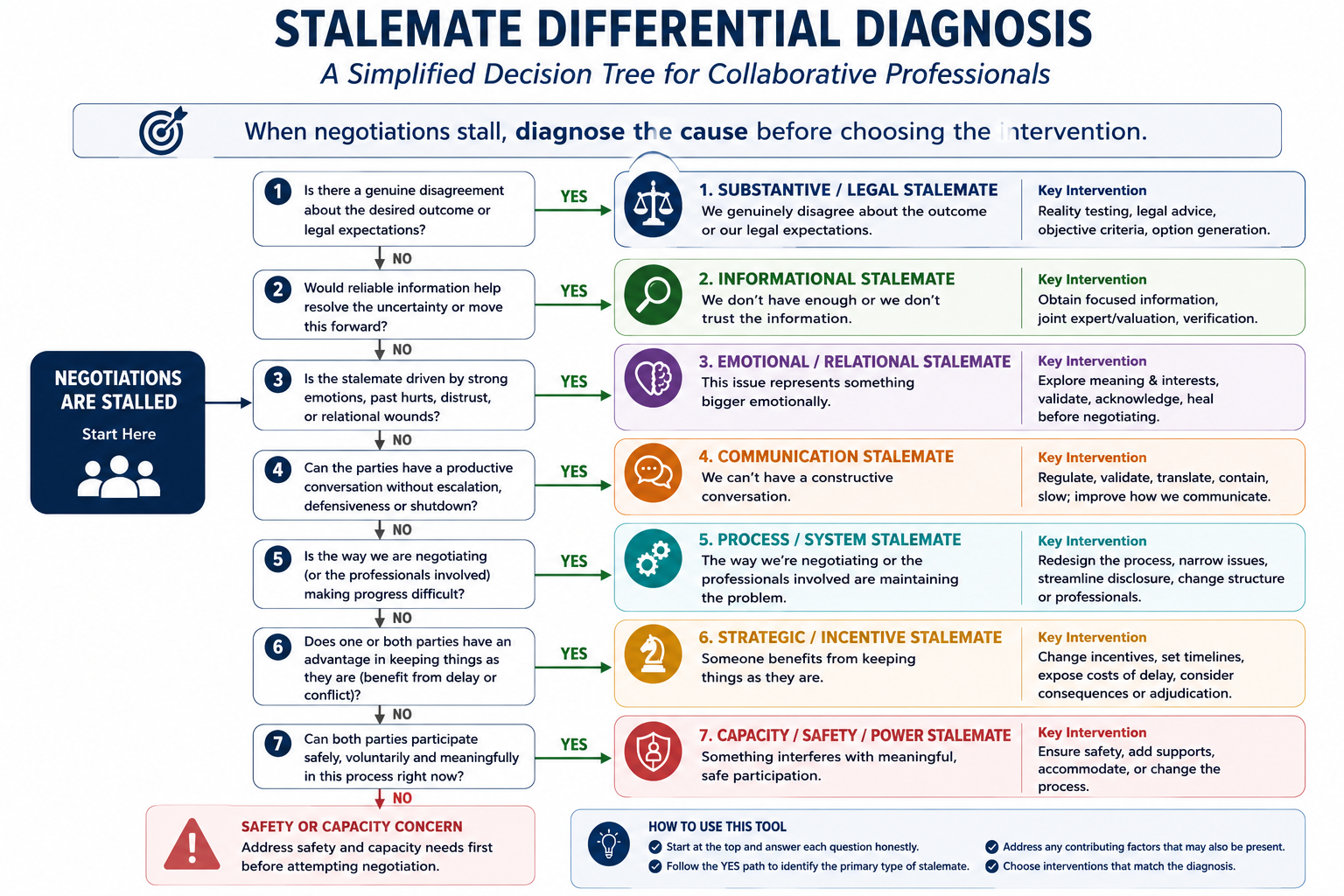

Breaking the Stalemate Case study:
Two parents who are teachers in their 30’s with two children, 4 and 6.
Still live in matrimonial home, with the father is sleeping on a mattress in a hallway in the basement, mother is living on the main floor and sleeps in the main bedroom.
Financial issues:
Both parties want to retain the home and buy the other party out. Parents have a mortgage on the house with virtually no equity in the home.
Parenting Issues:
Mother wants primary care of the children; father wants an equal parenting time schedule. The parents are currently exercising a shared parenting schedule and sharing time in the main area of the matrimonial home while the children are awake.
Legal Issues:
Father’s mother (paternal grandmother to the home) owns 50% of the home and does not have any debt related to the house, as she paid off her mortgage on the house and bought her ex-husband’s share of the home, which was sold to the parties. She has lived in the home for the past 35 years and the home is where the father has lived for his whole life, apart from a few years when he was living outside of the home with the mother.
What we need to resolve: Parenting Schedule and Retention of the Matrimonial Home
1. What is the conflict really about beneath parenting schedules, disclosure, and valuations?
2. What would you need to know before deciding whether this is inability, unwillingness, fear, or strategy?
3. Which intervention would you try first—and what evidence would tell you it is working?
4. What could your first intervention unintentionally make worse?